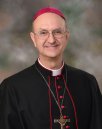

Last Saturday morning, I spent time with two groups of amazing people, the “convinced,” and those who have “yet to be.” The “convinced” were the women and men who recently completed a course in theology. They received certificates of completion and celebrated their success at Morning Prayer and breakfast at the Cathedral of Saints Peter and Paul. The “yet to be” were those I met going door to door with members of the Legion of Mary and Lay Missionary Servants of the Word. Saturday, I was with those who have already found Jesus Christ and know him as their Lord and Redeemer and those who are still searching.
We can all locate ourselves somewhere between the two experiences. Many of us are convinced or at least on our way there. We’ve met the Lord and his presence and power in our lives are real. There are still many people, however, who have yet to meet the Lord and experience his love.
So, who are those who have yet to be convinced? This deserves some consideration. I met them on Saturday morning on Woodbine Street. Knocking on doors, at times we were outright rejected; other times we were dismissed silently or with a simple, “I’m not interested.” Some individuals were curious. “Are you really Catholic?” they asked in disbelief. “Catholics go door to door?” Still others asked how they could connect or reconnect with Jesus and the Church. Their desire for the Lord was sincere.
We met “cultural Catholics,” those who identify as Catholics because of their culture or family, not because it’s a personal decision. We met “the indifferent,” those who are apathetic about the faith, so they leave the Church because they don’t care, are complacent, or are just lazy. We met “spiritual but not religious” Catholics, those who seek spiritual realities outside the Church. They recognize that the material world cannot define what it means to be human but base their spirituality on their subjective experience. They may know the Faith superficially.
On the street and at the door, we met the “disgruntled and the dissatisfied,” those who fall away from the Church because they disagree with the moral teachings of the Church. It could be that they haven’t been exposed to the full range of the teachings of the Church. We also met “flip floppers,” those who switch to other Christian churches because they want to keep their faith in Jesus but see the sacraments, liturgy, and other parts of Catholicism as inconvenient or unnecessary extras. We encountered “skeptics,” those who identify as agnostics and atheists due to the popularity of the atheist movement.
Pope Paul VI, in “On Evangelization in the Modern World,” wrote: “Evangelizing is in fact the grace and vocation proper to the Church, her deepest identity. She exists in order to evangelize.” Elaborating on this very theme, the National Directory for Catechesis details five stages of the Church’s evangelizing mission.
Pre-evangelization: This stage seeks to show that our basic human desires for security, love, and acceptance find their fulfillment in God. It answers the fundamental questions of life such as: Why do I exist? Where does everything come from? Why is the world the way it is? What is my purpose in this world?
Initial proclamation of the Gospel: This is directed toward non-believers, those fallen away, those of other religions, and the children of Christians. It seeks to make people aware of their sin and their need for salvation in Jesus Christ. The aim of this stage is conversion.
Initiatory catechesis: Now, after evangelization and conversion there is catechesis. This stage introduces, in an evangelizing way, the life of faith, the liturgy, and the love of God. It’s for those coming into the Church, those completing initiation, for children, and the young.
Mystagogical or post-baptismal catechesis: Catechesis doesn’t end at initiation. After baptism, people need to be led deeper into living the Christian life, receiving the sacraments, praying, and spreading the Gospel themselves.
Permanent or Continuing catechesis: Finally, at the end of the process, we come to the systematic presentation of the truths of the faith and the practice of the Catholic Faith. This is catechesis proper. It nourishes faith through deeper study and fosters continual, ongoing conversion.
This whole process relies on one key element, the Gospel, the Good News, must be proclaimed. And so, last Saturday, we told everyone we met about the love of Jesus. We explained that he gave his life for their salvation, that he cares deeply for them. Was anyone convinced? Perhaps not, but our witness offered a simple, direct message, “God is Love.” Many centuries have shown that the Holy Spirit will take care of the rest. Are you convinced? I certainly am.